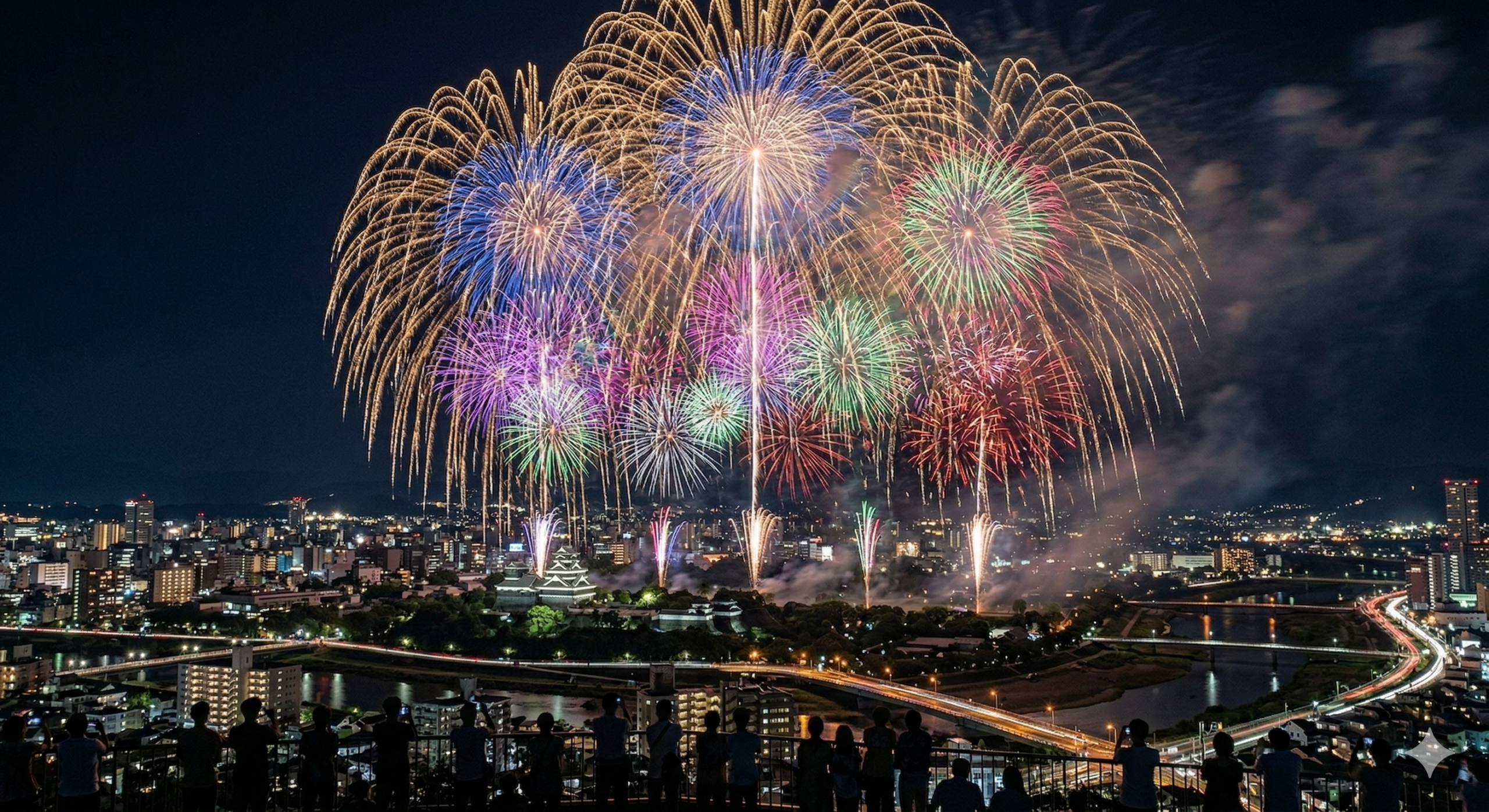
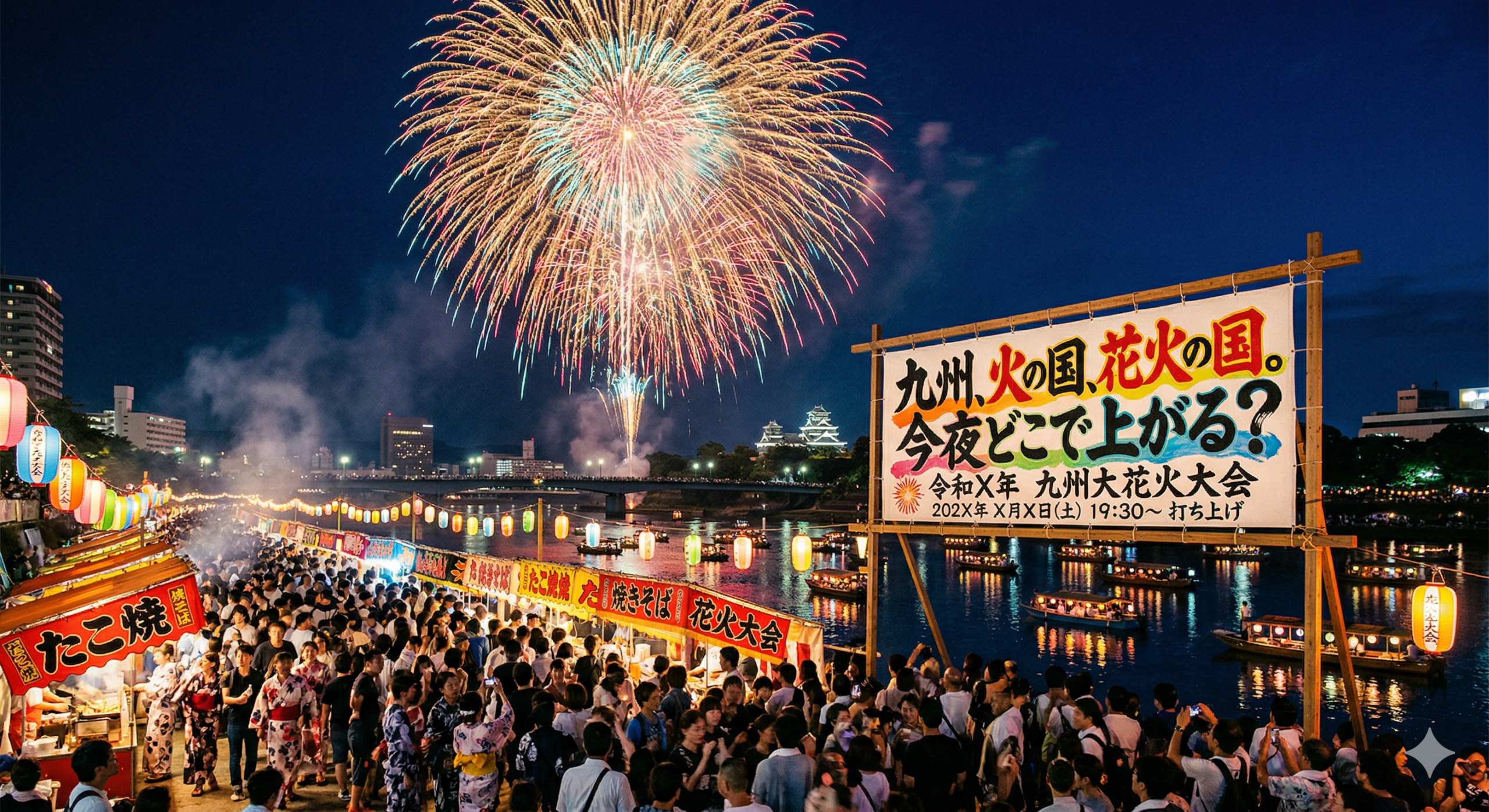
Japanese fireworks festivals feel different from fireworks shows in most other countries — and the shells themselves are a big reason why. Once you know a few names and shapes, watching a show transforms from “pretty explosions” into something you can actually follow and appreciate.
How a Japanese firework shell works
Most shells fired at Japanese festivals are spherical. Inside the shell, small chemical pellets called hoshi (星, “stars”) are arranged in a precise pattern. When the shell bursts, the stars fly outward and burn — and their arrangement determines the shape you see in the sky. Getting a perfect circle requires the stars to be distributed with near-perfect symmetry, which is why hand-crafting the shells takes years of skill.
Common types to look for
Wariboshi (割物) — the classic burst
The broad category of shells that open into a round shape. Most of what you see at a standard festival falls here. The shell cracks and the stars spread outward in a sphere.
Kikuboshi (菊) — chrysanthemum
Stars that leave long, trailing tails as they fall — the glow hangs in the air for a moment before fading. Named after the chrysanthemum flower. This is the shape most people picture when they think “Japanese firework.”
Botomu (牡丹) — peony
Stars that burn brightly but leave no tail — clean bright dots instead of trailing lines. The peony burst looks fuller and rounder than the chrysanthemum.
Yanagiboshi (柳) — willow
Long drooping golden tails that curve downward like willow branches. The effect is slow and graceful — many people’s favourite shape.
Kamuro (髪) — comet-like trails
Dense silver or gold trails that fall straight down like hair (the name means “hair of a child”). A very traditional shape.
Spinning shells (回転系)
Shells that spin as they burst, creating rings, rings within rings, or Saturn-like shapes. These require precise engineering and are a sign of a skilled maker.
Colour-changing shells
Multi-layered stars that change colour as they burn — red to blue, green to gold. The colour sequence is controlled by the chemical composition of each layer of the star.
Niwakahanabi (庭火) — low-level effects
Ground-level and low-altitude effects: waterfalls of sparks, Roman candles, strobes. Often used between major shells for contrast and rhythm.
Competitive vs. display festivals
Some festivals are competitions (花火競技大会) where licensed pyrotechnicians submit shells to be judged on technical skill and artistry. At these events, the programme often lists each shell’s name and maker — which is how to really follow along. Japan’s most famous competitive shows are at Ōmagari (Akita), Nagaoka (Niigata), and Tsuchiura (Ibaraki).
Display festivals (花火大会) focus on entertainment — music sync, colour sequences, volume of shells. Both are worth attending; they just feel different.
One tip for first-timers
Listen as well as watch. The low-frequency boom of a large shell — felt in the chest before you hear it properly — is part of the experience. Don’t watch through a screen the whole time.
Read next
- Fireworks festivals in Fukuoka & Kyushu: a traveler’s guide
- Will a Japanese fireworks festival be cancelled if it rains?
- How much does a single firework cost in Japan?
※本記事はアフィリエイト広告(楽天・Amazon)を含みます。
あわせて読みたい
花火カレンダー(全国の花火大会日程まとめ) と 花火マップ(開催地マップ一覧) で、気になる花火大会をまとめてチェックできます。